

We hope this message finds you well. We are reaching out to you since you have been a part of our programmes. It has been a delight to share ideas and insights with you during our events and webinars. If you wish to subscribe to our newsletter and get regular updates, please subscribe to our Substack.
Here is our latest edition for your information.
Editor’s Note:
Dear Reader,
This month, we explore a foundational perspective on what it truly means to learn meaningfully and grow as individuals. At the heart of this issue is the integrated framework of Skills, Processes, and Watermarks (SPWs) - three essential elements that together support wholistic development and lifelong learning.
In contrast to traditional education models that emphasize content acquisition, this approach highlights the how and why of learning. Skills provide the capacity to engage with the world—analyzing, communicating, and making informed decisions. Processes shape how learning unfolds through reflection, collaboration, and exploration. And Watermarks, the inner qualities like resilience, empathy, and curiosity, define the character and values that guide our actions.
What makes SPWs so powerful is their interconnected nature. They don’t operate in silos. Instead, they influence and reinforce one another, ensuring that learning is both functional and transformative. When learners set goals, reflect on their progress, and grow in both ability and disposition, education becomes a deeply personal and purposeful journey.
As you engage with this issue, we invite you to reflect on how these elements show up in your learning environments. How are we nurturing not just what learners know, but who they become?
Happy Reading!
Skills, Processes and Watermarks: Foundations for Meaningful Learning
by Choki Wangchuk
Skills, Processes and Watermarks are three interconnected elements that play a vital role in shaping how individuals learn, grow, and navigate the complexities of life. Together, they form a framework for understanding not just what is learned, but how learning happens and who the learner becomes in the process. Unlike traditional approaches that often prioritise the acquisition of content knowledge, this perspective emphasises the wholistic development of individuals through the cultivation of capabilities, dispositions, and reflective practices.
Understanding Skills
Skills refer to the abilities or capacities individuals use to acquire, interpret, analyse, and apply knowledge. They are functional, purposeful, and transferable across different contexts. Skills are not limited to academic domains but encompass a broad range of abilities essential in various areas of life.
Examples include analytical thinking, communication, comprehension, and decision-making. These skills allow individuals to engage effectively with their surroundings, adapt to changing circumstances, and contribute meaningfully to their environments. Importantly, skills are not static; they evolve through deliberate practice, reflection, and application.
For skills to develop meaningfully, individuals need opportunities to apply them in varied contexts. This requires moving beyond rote learning to engaging with tasks that demand creativity, reasoning, and adaptability. When learners set personal goals and actively monitor their progress, they take ownership of their skill development, making it dynamic and self-directed.
Educational practices in motion: a scoping review of embodied learning approaches in school
by Pierluigi Faella, Simone Digennaro, Alice Iannaccone
Courtesy: Frontiers in Education
Introduction
The concept of body has undergone profound transformations over time, often giving rise to misunderstandings, incomplete definitions, or oversimplifications (Fei, 2020). A recurring challenge lies in the notion of the body as an isolated entity–an autonomous mechanism capable of self-determination and transformation, independent of external influences. This perspective portrays the body as detached from the environment and society, operating in a vacuum devoid of relational and contextual factors. Such a view neglects the intricate and multifaceted reality of what the body represents (Digennaro and Iannaccone, 2023a, 2023b, Piccerillo et al., 2025).
Nevertheless, the concept should not be viewed as an isolated entity; rather, the body is a dense, interconnected weave of elements that transcend corporeality. It is not only the key to existence but also the window through which individuals perceive, interact with, and approach the world. Yet, existence itself cannot be reduced to mere corporeal presence. The body must be conceived as a junction–a dynamic link between nature and culture, individuality and collectivity, solidity and abstraction. It encapsulates the dualities of personal uniqueness and the inevitable adherence to social patterns (Digennaro, 2021; Digennaro and Iannaccone, 2023a; Digennaro and Iannaccone, 2025).
This nuanced understanding resonates with the central themes of phenomenology, a philosophical discourse that positions the body as fundamental to human existence. Phenomenology offers a robust framework for examining the body, not merely as an object of perception but as a lived and subjective entity intricately tied to the world. Philosophers such as Edmund Husserl (1960) pioneered this discourse, emphasizing the body’s role in consciousness and lived experience. Husserl’s groundbreaking work framed the body as a pivotal element in the intentionality of consciousness - the directedness of the mind toward objects and experiences in the external world. Keep reading
Transforming education for holistic student development
by Amanda Datnow, Vicki Park, Donald J. Peurach, and James P. Spillane
Courtesy: Brookings
The period since the founding of the United Nations Educational, Scientific, and Cultural Organization (UNESCO) in 1945 has been marked by an accumulating global agenda for transforming education for students in fundamental ways—including the recognition that education is a human right and a public good, that access is not tantamount to learning, and that academic learning is but one dimension of holistic student development (Figure 1). Each of these calls for global educational transformation has been invoked in response to crises regarding educational equity, quality, and purpose. These crises have been underscored by the COVID-19 pandemic, which brought the needs of the whole child to the forefront.
The global education policy arena is a crowded space, with many interests and voices competing for priority in motivating and framing agendas for improvement and innovation. In search of common ground, this report centers on two critical questions that should be matters of universal concern. Keep reading
Upcoming Event
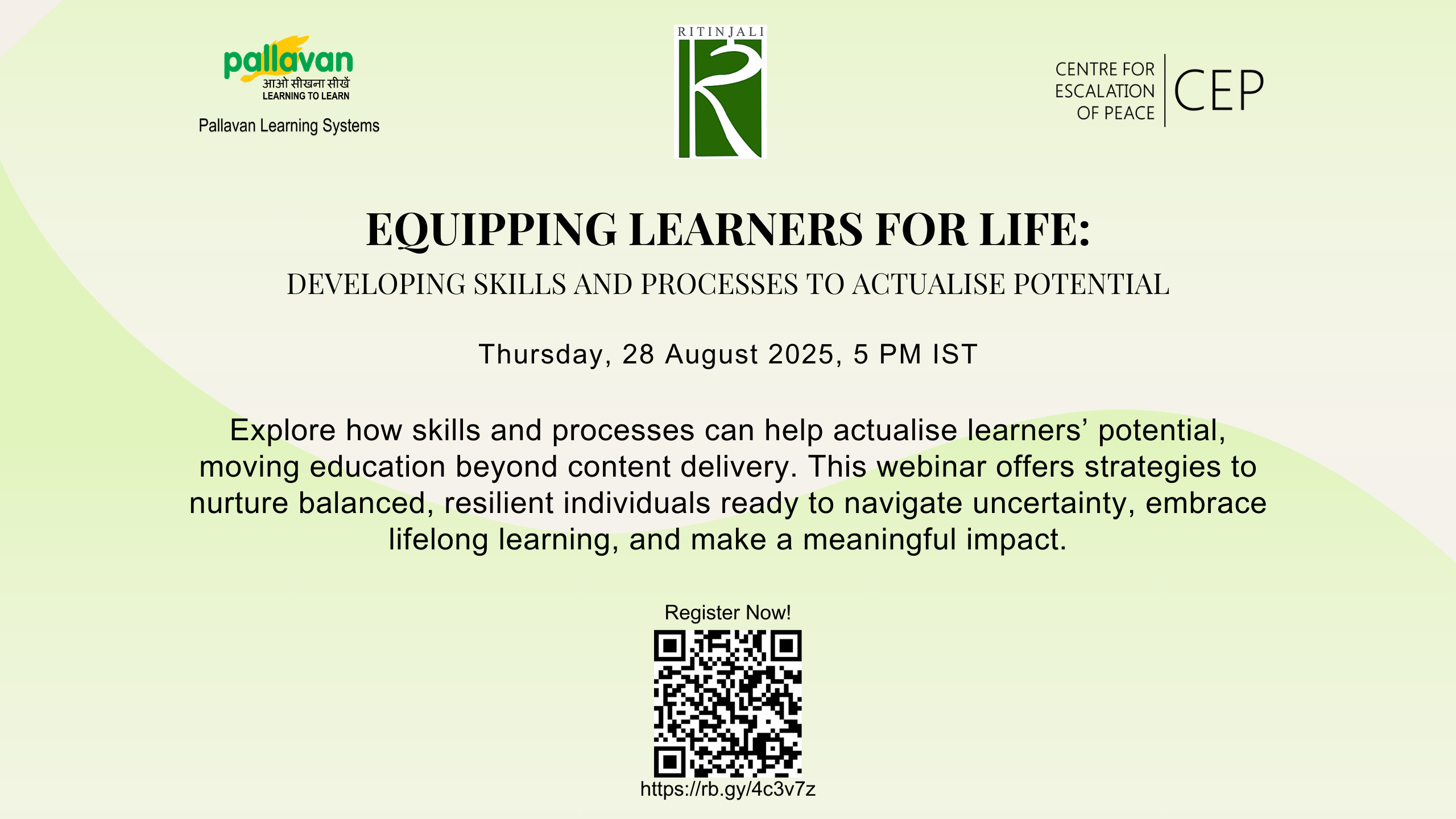
Equipping Learners for Life: Developing Skills and Processes to Actualise Potential
Past Events
Ayurveda to Integrative Health: A Holistic Path to Well-Being
Click here to read and access the webinar video.
Webinar: Adolescence & Technology: Growing Up in the Digital Age
Click here to read and access the webinar video.
Webinar: Reading in the Digital Age: Nurturing Readers in a Tech-Driven World. Click here to read the report. Watch the webinar.
Webinar: Enabling Environment: Integrating Technology, Inclusion, and Community. Click here to read the report and watch the recorded video.
Philosopher’s Retreat 2024: Navigating Human Connection and Development in the Age of Technology. To read the full report Click here.
New Online Courses

Prompt Engineering for Educators: AI-Powered Teaching equips educators with practical strategies to effectively use artificial intelligence (AI) tools—such as ChatGPT, Perplexity, and Meta AI—by mastering the skill of prompt engineering. Participants will learn how to craft precise and purposeful prompts to enhance their teaching practices, streamline lesson planning, create personalised learning experiences, and foster creativity in the classroom.

Developing a Reading Habit supports students aged 15 and above in cultivating a consistent and enjoyable reading habit. Through six interactive modules, it introduces techniques to select engaging books, overcome common reading challenges, and build a daily reading routine. Students explore a range of reading materials and strategies to strengthen comprehension and retention, ultimately fostering a lifelong love of reading.
For more such online courses, click here.
Services
Pallavan School, Jhalawar
The monthly engagement with Dr Dinesh Singh resumed on 5 July. He spoke on AI in education, scientific thinking, and the importance of conceptual learning, highlighting stories from Einstein to environmental science. Teachers were encouraged to design AI-based Python projects, explore Brownian motion, and continue classroom experiments like time-lapse photography. The session summary, video, and assignments were uploaded and made available on the PLS Portal for the school teachers.
A follow-up session on Phonics, conducted by Sangeeta from Pallavan Learning Systems on 1 August 2025, reviewed the implementation of the Jolly Phonics programme since its launch in May. The session highlighted the proactive efforts of Bhuvaneshwari from Pallavan Jhalawar, who has been leading weekly phonics sessions with children in Grades 1–3. With schools currently closed due to a heatwave, teachers have used this time for focused phonics training, planning to integrate newly developed sight word resource packs and multi-sensory strategies into their classrooms. Teachers also agreed to hold daily post-school learning sessions and dedicate time during lessons to reinforce phonetic awareness. Videos from Pallavan Jhalawar are being used as peer-learning tools, with ongoing sharing of resources via a dedicated WhatsApp group. A review is scheduled for October to assess continued progress and support sustained implementation.
Ritinjali
As part of a new 3-month programme being introduced at Ritinjali, the team at Pallavan Learning Systems has helped design a series of workshops rooted in its Five Areas of Development approach focusing on the wholistic growth of learners across the physical, emotional, social, cerebral, and spiritual domains. On 9th July, PLS outlined the session schedule for the programme, which includes two separate 8-hour modules tailored for two distinct groups: boys from the Second Chance School and girls from the Skilling Centre. The sessions are scheduled to run from 10th July to 11th September.
To initiate the programme, Choki Wangchuk conducted an engaging introductory session on 17 July 2025, where participants were introduced to the philosophy and objectives of the Five Areas of Development framework. The session set the foundation by helping learners understand how each area interconnects to support their overall personal and professional growth.
Following this, on 24 July 2025, Thupten Tsewang facilitated an in-depth session on Spiritual Development. This session focussed on developing inner goodness, identity, meaning and purpose, and going beyond self and others. Activities included guided reflections, meditation postures, and components of personal roadmap creation.
On July 31, 2025, Choki Wangchuk led a session on Social Development that centered on fostering connections and relationships. The session highlighted three key approaches: developing self-awareness and understanding others, promoting teamwork and collaboration, and encouraging active engagement with the community.
Thanks for reading PLS Newsletter! Subscribe for free to receive new posts and support our work.